
Parkland Formula Calculator : Burn Fluid Resuscitation Guide
Calculate IV fluids for burn patients using the Parkland Formula Calculator, Includes TBSA guide, first 8-hour, next 16-hour breakdown
Parkland Formula Calculator
Fluid Resuscitation Calculator for Burn Patients
Total Fluid Requirement (First 24 Hours)
Lactated Ringer’s solution is typically preferred.
First 8 Hours
0 mL
Continuous Infusion Rate: 0 mL/hr
Next 16 Hours
0 mL
Continuous Infusion Rate: 0 mL/hr
- Parkland Formula Calculator : Burn Fluid Resuscitation Guide
- Parkland Formula Calculator
- Total Fluid Requirement (First 24 Hours)
- 1. What is Parkland Formula?
- 2. What is Primary goal of Parkland Formula?
- 3. Why to use Our parkland burn formula calculator ?
- 4. When Parkland Formula IS used?
- You may also like:
- 5. How to Use Parkland Formula for burns?
- 4. How to use parkland formula for fluid calculation in burns?
- 6. How Much Fluid in First 8 Hours according to Parkland Formula?
- 7. How accurate is Parkland Formula?
- 8. Parkland Formula – Result Interpretation Chart 📊
- 9. Pediatric Considerations- Galveston Formula
- 10. What Is the Modified Parkland Formula?
- 11. Difference Between Parkland and Modified Parkland Formula
- 12. The Bottom Line
1. What is Parkland Formula?
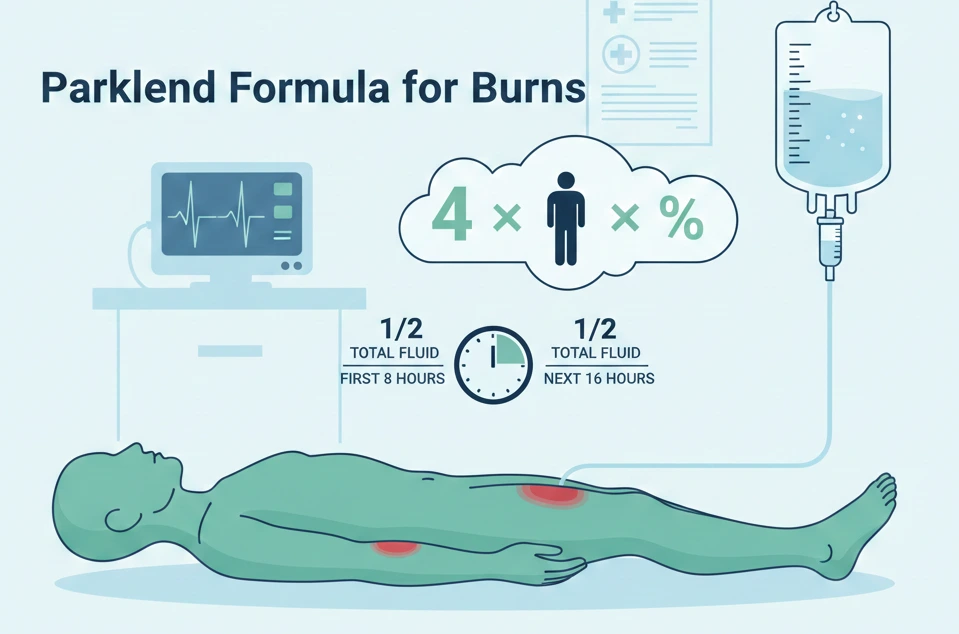
The Parkland formula is a clinical guideline used to estimate the initial intravenous (IV) fluid requirements for patients with major burn injuries during the first 24 hours after injury. It was developed at Parkland Memorial Hospital and remains one of the most widely used methods for early burn resuscitation worldwide.
2. What is Primary goal of Parkland Formula?
The primary goal of the Parkland formula is to:
- Prevent burn shock
- Maintain adequate tissue perfusion
- Reduce the risk of organ failure
- Support kidney function through appropriate urine output
3. Why to use Our parkland burn formula calculator ?
Accuracy and context are key. Many online calculators simply give you a number and leave you to wonder what it means. Our interactive parkland formula for burns calculator provides:
Real-time Visualization
See where you land on the spectrum instantly.
Data Privacy
All calculations happen locally; No personal metrics stored.
WHO Compliance
used Most up-to-date World Health Organization thresholds.
4. When Parkland Formula IS used?
The formula is typically used in:
You may also like:
Benefits of Garlic: Fight Cancer & Boost Health
How Physical Activity Helps Reduce LDL Cholesterol Naturally

5 Simple ways to Know You are Overweight to Act Early

Cholesterol and Heart Health: 5 Symptoms You Shouldn’t Ignore

5. How to Use Parkland Formula for burns?
The Parkland formula requires two essential inputs:
- Patient body weight (kg)
- Percentage of Total Body Surface Area burned (%TBSA)
Check Weight (kg)
Estimate %TBSA
4ml × kg × %TBSA
Total 24h Fluid
Half in First 8h
Half in Next 16h
Monitor Urine
Adjust Fluids
4. How to use parkland formula for fluid calculation in burns?
Fluid requirement (mL) = 4 × body weight (kg) × %TBSA burned
6. How Much Fluid in First 8 Hours according to Parkland Formula?
50% of the total calculated fluid volume should be administered within the first 8 hours after the burn injury occurred (not from hospital arrival).
Delayed presentation requires adjusting the infusion rate to ensure the correct volume is delivered within the remaining time.
Early fluid delivery is critical to prevent:
7. How accurate is Parkland Formula?
The Parkland formula is a widely accepted guideline for initial fluid resuscitation in major burns, but it is not perfectly accurate. It provides a starting estimate based on body weight and %TBSA burned. However, individual needs vary due to age, inhalation injury, electrical burns, delayed treatment, and comorbidities. Many patients require adjustment to avoid under- or over-resuscitation (“fluid creep”). Therefore, accuracy depends on close monitoring of urine output, vitals, and clinical response rather than the formula alone.
8. Parkland Formula – Result Interpretation Chart 📊
| Parameter | Target Range | Interpretation | Action |
|---|---|---|---|
| Urine Output (Adults) | ≥ 0.5 mL/kg/hr | Adequate perfusion | Continue current rate |
| < 0.5 mL/kg/hr | Under-resuscitation | Increase fluids gradually | |
| > 1 mL/kg/hr | Possible over-resuscitation | Reduce fluid rate | |
| Heart Rate | < 100 bpm (improving) | Stable | Monitor |
| Persistent tachycardia | Inadequate perfusion | Reassess fluids | |
| Blood Pressure | Stable MAP ≥ 65 mmHg | Adequate | Continue |
| Hypotension | Shock risk | Increase fluids / evaluate | |
| Serum Lactate | Decreasing | Good response | Continue |
| Rising | Tissue hypoxia | Escalate management | |
| Edema / Lung Signs | Minimal | Acceptable | Monitor |
| Increasing edema/crackles | Fluid overload | Reduce fluids |
Parkland Formula – Urine Output Monitoring (24 Hours)
9. Pediatric Considerations- Galveston Formula
In children:
- Urine output targets are higher (1 mL/kg/hr)
- Maintenance fluids must be added
- Glucose-containing fluids may be required
10. What Is the Modified Parkland Formula?
The Modified Parkland Formula refines traditional burn resuscitation by slightly lowering the total calculated volume. It reduces complications while maintaining adequate circulation during the first 24 hours.
This approach is especially helpful in modern burn care settings where over-resuscitation is a known risk.
11. Difference Between Parkland and Modified Parkland Formula
| Feature | Parkland Formula | Modified Parkland Formula |
|---|---|---|
| Fluid calculation | 4 mL/kg/% TBSA | 3–4 mL/kg/% TBSA |
| Purpose | Standard initial burn resuscitation | Reduce risk of over-resuscitation |
| Fluid type | Ringer’s Lactate | Ringer’s Lactate |
| First 8 hours | 50% of total volume | 50% of total volume |
| Next 16 hours | Remaining 50% | Remaining 50% |
| Risk of fluid overload | Higher | Lower |
| Current preference | Traditional teaching | Increasingly preferred in practice |
| Adjustment method | Based on urine output | Based on urine output |
12. The Bottom Line
The Parkland formula is a reliable starting point for fluid resuscitation in major burns, providing an initial estimate based on weight and %TBSA. Its accuracy depends on careful assessment and continuous monitoring. Clinical endpoints, especially urine output, hemodynamics, and lab markers, guide adjustments. Individualized, goal-directed resuscitation ensures effective perfusion while minimizing risks of under- or over-resuscitation.
13. Freqeuently asker Questions
Yes, the Parkland formula can be used for children, but with modifications. Children have higher fluid and caloric needs and require maintenance fluids in addition to burn resuscitation. Urine output targets differ (≈1 mL/kg/hr). Close monitoring is essential to avoid over- or under-resuscitation, especially in infants and small children.
Ringer’s lactate is the preferred fluid for initial burn resuscitation.
When considering the Parkland formula for fluid resuscitation in burn patients, the standard calculation for adults generally involves administering 4 mL of intravenous fluids per kilogram of body weight for each percentage of total body surface area (%TBSA) burned. However, this isn’t a universally fixed rule; these volumes are frequently adjusted. For instance, children often receive a slightly lower amount, typically 3 mL.
When determining a patient’s maintenance fluid requirements, clinicians typically use what’s known as the ‘4-2-1 rule.’ This guideline specifies administering 4 milliliters per kilogram per hour for the first 10 kilograms of a patient’s body weight. For the next 10 kilograms, the rate decreases to 2 milliliters per kilogram per hour. Any weight beyond that initial 20 kilograms receives 1 milliliter per kilogram per hour. A crucial point to remember is that the overall hourly maintenance fluid volume should not surpass 100 milliliters.
No. It is generally reserved for burns involving ≥10–15% TBSA.
The Modified Parkland formula was introduced to address “fluid creep,” a problem seen with excessive resuscitation that can cause edema, compartment syndrome, and respiratory complications.
Many burn centers now prefer the Modified Parkland formula because it provides adequate resuscitation while minimizing complications related to over-resuscitation.
No post found!
For Nutrition related articles, click here.