
Lund and Browder Chart Calculator (Free TBSA Burn % Tool for Adults & Children
Calculate burn percentage accurately using the most reliable method for all age groups.
Enter Age → Select Burn Areas → Get TBSA % instantly

This professional tool calculates Total Body Surface Area (TBSA) for burns, adjusting proportions based on patient age for clinical accuracy.
Medical Disclaimer: This Calculator is for Education and Reference and does not replace Expert Advise.
1. Introduction- Lund and Browder Chart Calculator
The Lund and Browder Chart Calculator helps healthcare professionals estimate total body surface area (TBSA) affected by burns with greater accuracy than older methods. Because burn severity guides fluid resuscitation and referral decisions, correct calculation matters from the very first evaluation. Burn assessment demands speed and precision.
This tool improves clinical judgment by adjusting body surface percentages according to age. As a result, it works well for both adults and children. Moreover, its structured format reduces common estimation errors seen in emergency settings.
Early and precise TBSA calculation improves survival rates, guides fluid therapy using formulas like Parkland, and supports timely referral to burn centers. Therefore, using a reliable digital calculator can significantly enhance patient outcomes in both emergency and critical care units.
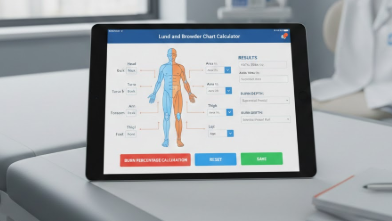
2. What Is the Lund and Browder Chart and Why it matters Medically?
The Lund and Browder chart is a medical tool developed to assess burn size by dividing the body into specific anatomical regions. Each region represents a percentage of TBSA. Unlike the Rule of Nines, this chart adjusts percentages based on age. For example, children have proportionally larger heads and smaller legs compared to adults. Consequently, age-based adjustments provide more accurate estimates.
Today, the Lund and Browder Chart Calculator converts this paper-based method into a fast digital solution. It minimizes manual errors and speeds up clinical workflow.
3. History of Lund and Browder Chart
1940
Dr. Charles Lund and Dr. Newton Browder developed a detailed chart for burn size estimation, improving accuracy over the Rule of Nines.
1950s
The chart became widely adopted in burn units, especially for pediatric patients where body proportions differ significantly from adults.
1960s
Modifications introduced for varying age groups, making the chart more precise in calculating TBSA for children and infants.
Modern Era
Today, the Lund and Browder Chart is a standard reference; digital and app-based versions are used in hospitals to speed up burn assessment and fluid calculation.
4. Why Use a Lund and Browder Chart Calculator?
Accuracy is critical in burn care. Even small percentage errors can lead to under- or over-resuscitation.
Digital tools allow quick reassessment during monitoring. following are the reasons
Lund and Browder Chart Benefits
Why TBSA Calculation Matters?
- Guides fluid resuscitation
- Determines burn severity
- Helps treatment planning
5. How the Lund and Browder Chart Calculator Works
The Lund and Browder Chart Calculator divides the body into sections such as:

You simply enter the patient’s age and mark affected areas. The system automatically calculates TBSA. Therefore, clinicians can focus more on treatment rather than manual computation. Many platforms also function as a TBSA burn assessment chart online, allowing access via mobile, tablet, or desktop.
What Happens After TBSA Calculation?
- Determines fluid resuscitation
- Guides hospital admission
- Helps predict severity
6. Pediatric Accuracy and Age Adjustments
Children require special consideration. Their body proportions change as they grow. Because of this, adult-based calculations often produce inaccurate results in pediatric patients.
A Lund and Browder chart pediatric calculator adapts percentages based on age groups and age based. For example, infants have a larger head percentage compared to teenagers. Consequently, pediatric burn care becomes more precise and safer.
Moreover, accurate TBSA estimation directly influences fluid replacement therapy in children, reducing complications such as fluid overload.
7. Modified and Advanced Digital Versions
Modern systems now include enhanced digital layouts. A modified Lund and Browder burn calculator often provides interactive diagrams, color coding, and severity grading. These improvements make the calculator easier to use in emergency departments. Furthermore, many platforms integrate electronic health records, improving workflow efficiency. Some versions even function as a detailed burn surface area estimation tool, enabling documentation of burn depth along with percentage.
8. Monitoring and Reassessment
Burn wounds evolve over time. Therefore, reassessment is essential within the first 24–48 hours.
The Lund and Browder Chart Calculator allows repeated entries to monitor changes in TBSA. This feature helps clinicians adjust fluids, medications, and surgical planning as needed.
While digital tools improve accuracy, they do not replace clinical judgment. Always confirm burn depth and reassess swelling or tissue changes. Inaccurate area marking can still produce incorrect TBSA results, even with automated calculations.
Psychological Impact of Burns
- Burns can cause PTSD
- Long recovery → stress
- Emotional trauma
If you are experiencing stress or trauma after an injury, consider taking the PTSD Test (PCL-5) or the Perceived Stress Scale (PSS).
9. Lund & Browder vs Rule of Nines
| Feature | Lund & Browder | Rule of Nines |
|---|---|---|
| Age Adjustment | Yes | No |
| Pediatric Accuracy | High | Limited |
| Complexity | Moderate | Simple |
| Emergency Speed | Fast (Digital) | Very Fast |
| Accuracy | Very High | Moderate |
| Method | Best For | Accuracy |
|---|---|---|
| Lund & Browder | Children | High |
| Rule of Nines | Adults | Moderate |
| Palm method | Small burns | Low |
10. Burn Assessment Accuracy
Accuracy Level (%)

Lund & Browder (Digital)  |████████████████████| 95%
Rule of Nines             |███████████████     | 80%
Palm Method               |██████████          | 60%
As shown above, the Lund and Browder Chart Calculator provides superior precision compared to traditional estimation methods.
11. Latest Research Insights
Recent burn care research emphasizes digital assessment tools to improve TBSA accuracy and reduce resuscitation errors. Studies show that electronic Lund-Browder systems decrease calculation variability by up to 15% compared to manual charting. Furthermore, integration with AI-assisted imaging may soon enhance automated burn mapping in emergency departments worldwide.
12. Clinical Benefits in Emergency Care
Emergency teams rely on rapid decisions. The Lund and Browder Chart Calculator supports:
In addition, proper TBSA estimation influences grafting strategies and long-term rehabilitation planning. Because burn injuries remain a major global health concern, standardized digital assessment tools improve patient safety and treatment consistency.
13. Practical Steps to Use the Calculator
The Lund and Browder Chart Calculator simplifies complex evaluation into a clear, structured process. Follow these steps for effective use:
“Accurate burn size estimation is not just a number—it directly shapes survival outcomes, fluid management, and long-term recovery. Digital precision in TBSA calculation can make the difference between complications and optimal care.”
14. The Bottom Line
Burn management begins with accurate assessment. The Lund and Browder Chart Calculator provides a reliable, age-adjusted, and efficient method to estimate TBSA in both adults and children. Compared to older techniques, it reduces errors and improves clinical confidence.
Healthcare professionals, educators, and emergency responders benefit from using this digital solution. Ultimately, consistent and precise TBSA evaluation leads to better patient outcomes and safer treatment decisions.
If you work in emergency care or medical education, integrating the Lund and Browder Chart Calculator into your workflow can significantly enhance burn assessment accuracy and efficiency.
Recovery from burns is not only physical but also emotional and lifestyle-related
Maintaining a healthy lifestyle can improve recovery outcomes—learn more in our lifestyle risk guide.
15. Frequently Asked Questions
The Lund and Browder Chart is a detailed tool used to estimate Total Body Surface Area (TBSA) burned in patients, accounting for age-related body proportion differences.
Unlike the Rule of Nines, which uses fixed percentages, the Lund and Browder Chart adjusts body region percentages for children and adults for more accurate burn size estimation.
Body proportions change with age, especially head and limb size. The chart accounts for these differences to avoid over- or underestimation of burn area.
Each body region is assigned a percentage of TBSA according to age. The clinician marks burned areas on the chart and sums the percentages to calculate total burn size.
It is used during initial assessment in burn patients to guide fluid resuscitation and estimate severity for treatment planning.
Yes, clinicians mark all affected areas, but fluid resuscitation typically considers burns ≥15–20% TBSA, often full-thickness or deep partial-thickness.
Yes, it is especially valuable in pediatric patients, as their body proportions differ significantly from adults, making Rule of Nines less accurate.
When used correctly, it provides a more precise TBSA estimate than generalized methods, reducing the risk of fluid over- or under-resuscitation.
Yes, it remains the standard reference for pediatric and complex burn assessments, though many centers use digital or app-based calculators for faster calculation.
Yes, TBSA estimated with the chart is a key input for formulas like Evans, Parkland, or modified Brooke to calculate 24-hour fluid requirements accurately.

5 Therapy Types That Help Meningitis survivors Heal Mentally
5 Therapy Types That Help Meningitis survivors Heal Mentally 1. Introduction Surviving Meningitis is not…

Digital Hangover: How Screen Time Impacts Mental Health
Digital Hangover: How Screen Time Impacts Mental Health 1. Introduction In today’s always-connected world, many…
Caring for Dementia: How to Protect Mental Health as Memory Fades
Caring for Dementia: How to Protect Mental Health as Memory Fades 1. Introduction: Dementia Caring…
Author
Related Health Guides
- Mental Health Assessment Tools
- Lifestyle Risk & Prevention Guide
- Burn Treatment & Fluid Calculation