
Burn Depth Classification: First, Second, Third and Fourth Degree Burns
Burn depth classification refers to how deeply skin layers are damaged, ranging from first-degree (superficial) to fourth-degree (affecting muscle and bone). It helps determine severity, treatment, and healing time.
| Degree | Skin Layer | Symptoms | Pain | Healing |
|---|---|---|---|---|
| 1st | Epidermis | Red, dry | Painful | 3–7 days |
| 2nd | Dermis | Blisters | Severe | 2–3 weeks |
| 3rd | Full thickness | White/charred | No pain | Surgery |
| 4th | Muscle/Bone | Black, deep | No pain | Emergency |
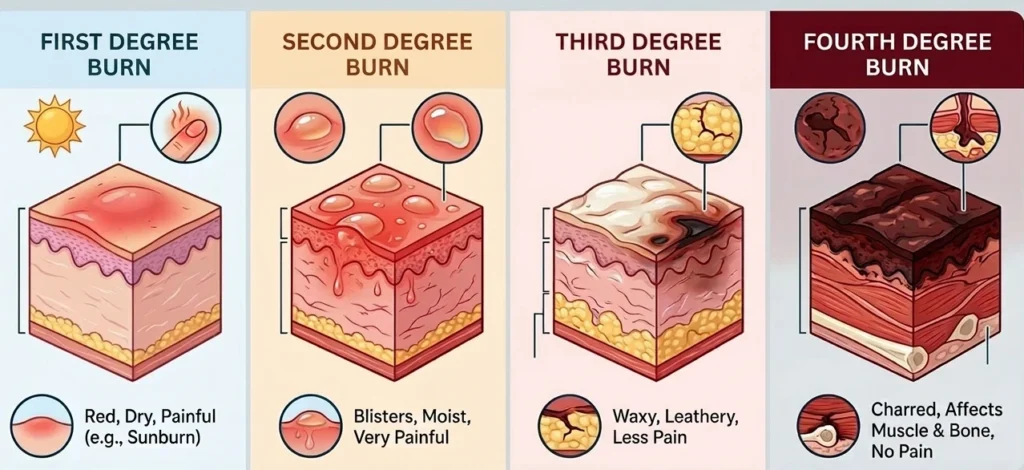
Medical Disclaimer: This is for Educational purpose only.

- Burn Depth Classification: First, Second, Third and Fourth Degree Burns
- 1. Introduction to Burn Depth
- 2. Understanding Burn Depth Classification
- 3. Superficial vs deep partial thickness
- 4. Superficial Burns
- 5. Partial Thickness Burns
- 6. Full Thickness Burns or Third degree burns
- 7. Deep Burns or Fourth degree burns
- 8. Quick Diagnosis Table on Burn Degree Classification
- 9. How to Identify Burn Degree (Step-by-Step)?
- 10. When to Go to Hospital
- 11. Monitoring and Assessment
- 12. How much is Healing Time when Treatment starts
- 13. Burn Severity vs Burn Depth
- 14. Latest Research in Burn Depth Classification
- 15. The Bottom Line
- 16. References
- Frequently Asked Questions
1. Introduction to Burn Depth
Burn injuries affect millions of people worldwide every year. Understanding Burn Depth is essential for accurate diagnosis, treatment planning, and predicting healing outcomes. Doctors often rely on burn depth classification, which divides injuries into different degrees of burns depending on how deeply the skin layers are damaged. This method of burn classification by depth helps clinicians choose appropriate care and avoid complications.
Knowing the types of burns by degree improves early first aid decisions and patient education. In addition, the standard burn injury classification guides medical professionals in assessing severity, estimating healing time, and deciding whether advanced treatment or hospital referral is required.
Early assessment of burn severity helps prevent complications such as infection, fluid loss, and tissue necrosis. Thus, healthcare providers evaluate the Burn Depth along with total body surface area and patient factors to determine the safest treatment approach.
2. Understanding Burn Depth Classification
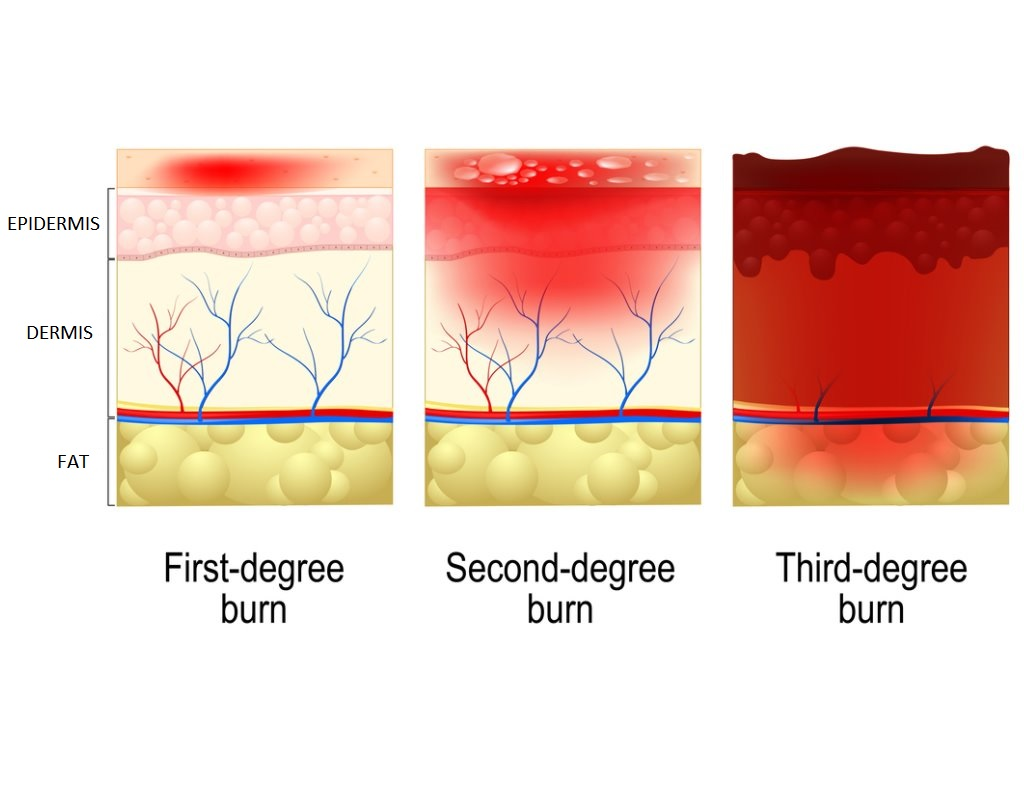
Doctors categorize burns based on how deeply heat damages the skin layers. The skin contains three main layers: epidermis, dermis, and deeper structures like muscle or bone.
Burn classification by depth generally includes four categories. Each category represents different degrees of burns, ranging from mild to life-threatening.
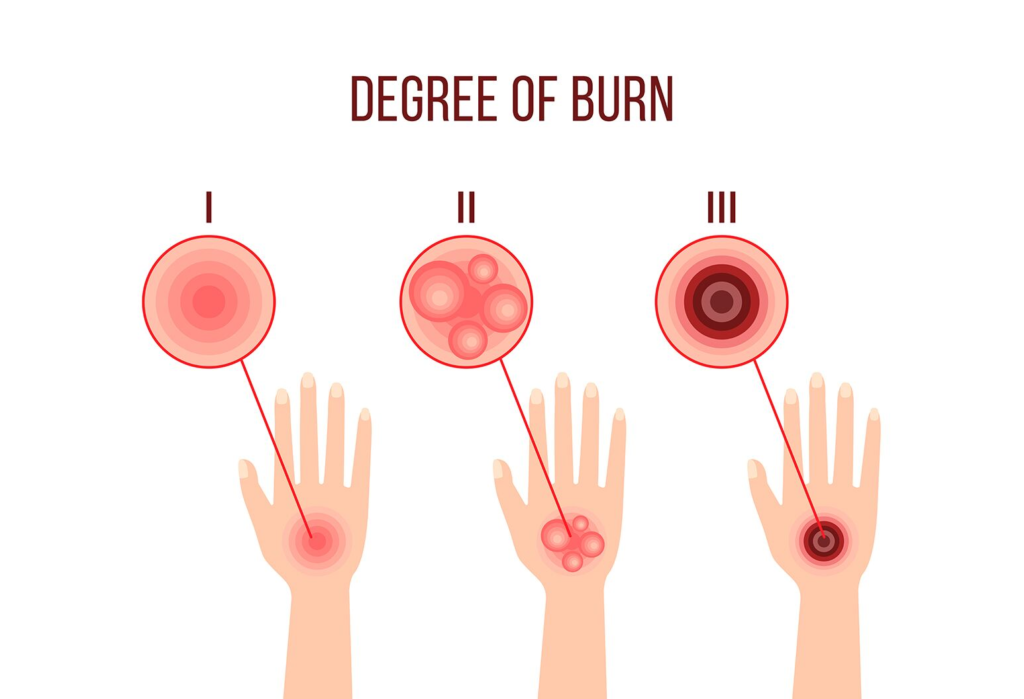
i. Superficial Burns
- Affects only the epidermis (top skin layer).
- Skin appears red, painful, and dry without blisters.
- Example: mild sunburn.
ii. Partial Thickness Burns
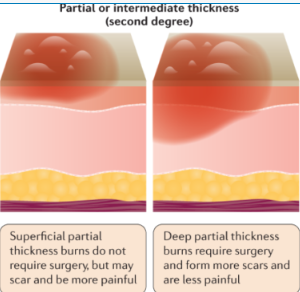
- Extends into the dermis layer.
- Usually red with blisters and severe pain.
- Divided into superficial partial and deep partial thickness burns.
iii. Full Thickness Burns
- Destroys epidermis and dermis completely.
- Skin may appear white, brown, or charred.
- Often less painful initially due to nerve damage.
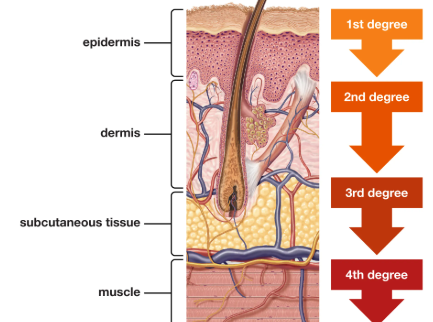
iv. Deep Burns
- Extends beyond skin into fat, muscle, or bone.
- Often called fourth-degree burns.
- Requires surgical treatment or grafting.
3. Superficial vs deep partial thickness
| Feature | Superficial Partial Thickness | Deep Partial Thickness |
|---|---|---|
| Skin layers involved | Epidermis + upper dermis | Epidermis + deeper dermis |
| Appearance | Red or pink, moist, shiny | Pale, patchy red/white, less moist |
| Blisters | Common and fluid-filled | May be present but less prominent |
| Pain | Very painful (nerve endings intact) | Less painful (nerve damage) |
| Texture | Soft and wet | Waxy or slightly dry |
| Healing time | 1–3 weeks | 3–8 weeks |
| Scarring | Minimal or none | Higher risk of scarring |
| Treatment | Basic wound care, dressings | Advanced care, may need surgery |
| Sensation | Highly sensitive | Reduced sensitivity |
4. Superficial Burns
Superficial burns represent the mildest form in Burn Depth evaluation. These injuries affect only the outermost layer of the skin called the epidermis.
Common first degree burn symptoms include: Redness of skin, Mild swelling, Pain or tenderness and No blister formation . For example, mild sunburn is a typical superficial burn. Usually heals within 3–7 days without scarring and Minimal medical intervention required. Even mild burns require monitoring to prevent infection.
• Cool the area with running water for 20 minutes
• Apply soothing moisturizer or aloe gel
• Avoid ice directly on the skin
• Keep the skin clean and hydrated
5. Partial Thickness Burns
Partial thickness burns damage both the epidermis and part of the dermis. These injuries form a major part of Burn Depth evaluation in emergency care. They are commonly described as second-degree burns.
Typical second degree burn treatment decisions depend on severity. Symptoms include: Blisters, Moist or red skin, Moderate to severe pain, Swelling and inflammation
These burns are divided into two types:
a. Superficial Partial Thickness Burn
b. Deep Partial Thickness Burn
– Gentle wound cleaning
– Sterile dressings
– Pain management
– Topical antimicrobial creams
In addition, severe cases may require hospital monitoring.
6. Full Thickness Burns or Third degree burns
Full thickness burns represent severe injuries in Burn Depth assessment. These burns destroy both the epidermis and dermis layers.
Doctors identify third degree burn characteristics such as White or charred skin, Dry leathery appearance, Reduced sensation due to nerve damage.
Healing usually requires advanced medical care:
Without treatment, infection and tissue loss may occur.
7. Deep Burns or Fourth degree burns
Deep burns are the most severe injuries in Burn Depth classification. These burns extend beyond the skin into muscle, fascia, or even bone. They are referred to as fourth degree burn injury.
Symptoms includes Black or charred tissue, Loss of sensation and Severe tissue destruction. Deep burns often require emergency surgical intervention.
• Call emergency medical services
• Protect airway and breathing
• Cover wound with sterile dressing
• Transfer to burn center urgently
8. Quick Diagnosis Table on Burn Degree Classification
| Degree | Skin Layer | Symptoms | Pain | Healing |
|---|---|---|---|---|
| 1st | Epidermis | Red, dry | Painful | 3–7 days |
| 2nd | Dermis | Blisters | Severe | 2–3 weeks |
| 3rd | Full thickness | White/charred | No pain | Surgery |
| 4th | Muscle/Bone | Black, deep | No pain | Emergency |
9. How to Identify Burn Degree (Step-by-Step)?
These features help clinicians assess how deeply the skin has been damaged. In addition, healthcare providers compare the characteristics of partial-thickness burns and full-thickness burns to determine the severity of the injury and guide appropriate management and care.
- Step 1: Check skin color – Red suggests mild; white, brown, or charred indicates severe.
- Step 2: Assess pain level – Painful burns are often superficial; painless may mean deeper nerve damage.
- Step 3: Look for blisters – Presence of blisters usually indicates a second-degree burn.
- Step 4: Examine skin texture – Dry = first-degree; moist = second-degree; leathery = third-degree.
- Step 5: Check swelling – Common in mild to moderate burns.
- Step 6: Test sensitivity – Gently touch; no feeling may indicate severe burn.
- Step 7: Estimate depth – Surface vs deeper layers involvement.
- Step 8: Seek medical help – Always for severe or unclear burns.
The Estimation of Burn Size is very important for Burn Fluid resuscitation calculation.
10. When to Go to Hospital
Go to the hospital immediately
- if the burn appears deep, with white, charred, or leathery skin, as this may indicate severe tissue damage.
- if the burn is larger than the size of your palm or covers a significant area of the body.
- if burns involve sensitive areas like the face, hands, feet, genitals, or major joints.
- f there is severe pain, numbness, or signs of infection such as pus, swelling, or fever.
- electrical or chemical burns, and for burns in children or elderly individuals.
11. Monitoring and Assessment
Continuous monitoring helps detect complications such as infection or fluid imbalance. Healthcare professionals examine wound healing, tissue color, pain levels, and vital signs to determine whether the injury is improving or worsening over time.
Burn wounds may appear mild initially but deepen within the first 24–48 hours. Patients should seek medical evaluation if pain increases, swelling spreads, or blisters enlarge. Early treatment significantly reduces complications.
12. How much is Healing Time when Treatment starts
- First-degree burns usually heal within 3–7 days; treat with cool running water, soothing lotions like aloe vera, and pain relief.
- Second-degree burns may take 1–3 weeks; keep clean, use antibiotic ointment, cover with sterile dressing, and avoid popping blisters.
- Third-degree burns require immediate medical care and may take months; treatment includes surgery, skin grafts, and hospitalization.
- General care includes staying hydrated, avoiding sun exposure, and keeping the wound clean.
- Seek medical attention if healing is slow, painful, or shows signs of infection.
| Burn Type | Healing Time | Notes |
|---|---|---|
| First-degree (Superficial) | 3–7 days | Heals quickly without scarring; affects only outer skin |
| Superficial Partial Thickness | 1–3 weeks | Usually heals well with minimal scarring |
| Deep Partial Thickness | 3–8 weeks | Slower healing; higher chance of scars |
| Third-degree (Full Thickness) | Months or longer | Requires medical treatment like surgery or skin grafting |
| Fourth-degree | Very prolonged (months to years) | Severe damage to deeper tissues; often needs complex surgical care |
13. Burn Severity vs Burn Depth
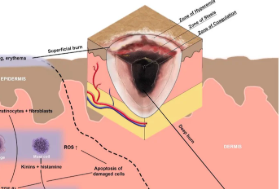
This visual comparison highlights how injury severity increases from superficial to deep burns.
14. Latest Research in Burn Depth Classification
Recent studies highlight improvements in diagnostic accuracy for Burn Depth assessment. According to research published in the journal Burns by the Elsevier medical research platform, modern imaging tools such as laser Doppler imaging significantly improve burn depth evaluation. These technologies help doctors differentiate superficial and deep injuries early, allowing faster treatment decisions and reducing unnecessary surgery.
“Accurate evaluation of burn severity remains the cornerstone of effective burn management. Early identification of tissue damage helps clinicians provide targeted treatment and significantly improves patient recovery outcomes.”
15. The Bottom Line
Understanding Burn Depth helps healthcare professionals and patients recognize burn severity and respond appropriately. The structured burn depth classification system explains the degrees of burns, from superficial injuries to life-threatening deep tissue damage. Identifying types of burns by degree allows early treatment decisions and reduces complications.
By recognizing symptoms, comparing superficial vs deep burns, and seeking timely medical care, patients can significantly improve healing outcomes. Ultimately, accurate burn injury classification remains essential for effective treatment, patient safety, and successful recovery.
16. References
Frequently Asked Questions

Top 10 Hidden Health Risks You Shouldn’t Ignore in 2026 (Early Signs & Prevention Guide)
Top 10 Hidden Health Risks You Shouldn’t Ignore in 2026 (Early Signs & Prevention Guide)…

Benefits of Garlic: May Fight Cancer & Boost Health
Benefits of Garlic: May Fight Cancer & Boost Health 1. Introduction “Garlic has been used…

How Physical Activity Helps Reduce LDL Cholesterol Naturally
How Physical Activity Helps Reduce LDL Cholesterol Naturally High LDL cholesterol silently damages your arteries…
Medical Disclaimer: The Website does not provide medical, clinical, or healthcare advise services. The content should not be relied upon as medical advice. Always seek the guidance of a qualified physician, healthcare provider, or medical professional with any questions you may have regarding a medical condition, treatment, or health decision. Never disregard professional medical advice or delay seeking it because of information found on this Website.