
Total Body Surface Area (TBSA) Calculator for Burn size estimation
One of the most essential tools in modern burn management is the TBSA Burn Calculator
1 Affected Body Areas
2 Patient Weight
3 Results
Parkland Fluid Requirement
- Total Body Surface Area (TBSA) Calculator for Burn size estimation
- 1 Affected Body Areas
- 2 Patient Weight
- 3 Results
- 1. Introduction of TBSA Burn Calculator
- 2. History of TBSA Burn Calculator (Rule Of Nine)
- 3. What Is TBSA in Burn Assessment?
- 4. How a TBSA Burn Calculator Works
- 4. TBSA Burn Calculator for Accurate Burn Size Estimation
- 5. TBSA Burn Calculator in Emergency Monitoring
- 6. Benefits of Digital Calculation
- 7. Burn Assessment Process
- 8. TBSA Burn Calculator for Burn Patients: Key Considerations
- 9. Accuracy and Professional Use
- 10. TBSA Burn Calculator- Manual vs Digital Burn Estimation
- 11. Latest Research and Evidence
- 13. When to Refer to a Burn Center
- 14. Common Mistakes in Burn Area Estimation
- 15. TBSA Burn Calculator – Key Advantages at a Glance
- 16. The Bottom Line
- 17. Frequently Asked Questions
1. Introduction of TBSA Burn Calculator
One of the most essential tools in modern burn management is the TBSA Burn Calculator. Burn injuries can range from minor to life-threatening, and assessing their severity by TBSA Burn Calculator accurately is crucial.
TBSA stands for Total Body Surface Area, and calculating the percentage of the body affected by burns helps clinicians determine fluid resuscitation needs, predict patient outcomes, and guide treatment strategies. For medical students, healthcare professionals, and even first responders, understanding and using a TBSA Burn Calculator is vital.
Using this tool ensures that burn patients receive timely and appropriate care. It also reduces human error in estimation, which is particularly important during emergencies when decisions must be fast and precise. In this article, we will explore the significance of TBSA calculation, different methods including the Rule of Nine, online tools, and practical applications of the TBSA Burn Calculator, along with the latest research insights.
2. History of TBSA Burn Calculator (Rule Of Nine)
1920s
Early research on Total Body Surface Area estimation.
1944
Wallace introduced the Rule of Nine.
1950s–60s
Global adoption in trauma care.
1970s
Lund & Browder chart improved pediatric accuracy.
1980s–90s
Integrated into ATLS & resuscitation protocols.
2000s+
Digital tools & AI integration.
3. What Is TBSA in Burn Assessment?
Total Body Surface Area refers to the percentage of skin affected by a burn injury. Clinicians use this measurement to determine severity, hospital admission needs, and fluid therapy.
The most common method for adults is the Rule of Nine, which divides the body into sections representing 9% or multiples of 9%. For children, adjustments are necessary because body proportions differ. However, location and depth also matter.
Burn severity classification generally includes:
4. How a TBSA Burn Calculator Works
A TBSA Burn Calculator simplifies complex estimations into quick digital results. Instead of manual calculations, users select affected body parts, and the system automatically computes the percentage.
Basic Estimation Methods
1. Rule of Nine Method- TBSA Burn Calculator
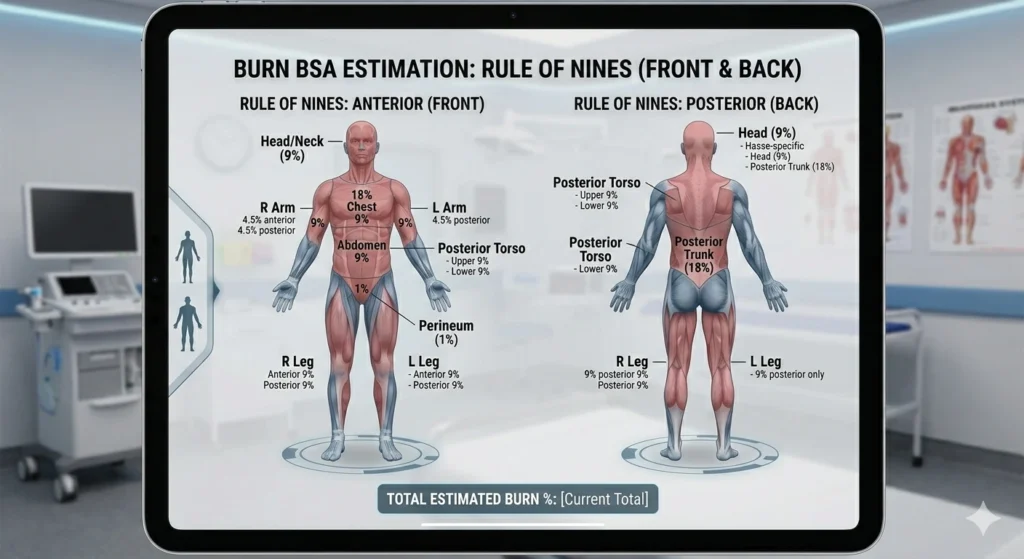
This method works best for adults.
2. Palmar Method
The patient’s palm (including fingers) equals roughly 1% of Total Body Surface Area. This technique helps estimate irregular burn size patches.
3. Lund and Browder Chart
This method provides age-adjusted values. It is more accurate for children.
4. TBSA Burn Calculator for Accurate Burn Size Estimation
Estimating the size of a burn is more than just a number—it directly influences patient care. The total surface area affected by burns determines the volume of fluids a patient requires, helps predict complications, and guides whether the patient needs to be transferred to a specialized burn unit.
A minor miscalculation in burn percentage can have serious consequences. Overestimation may lead to unnecessary fluid overload, while underestimation may result in hypovolemia and organ failure. Therefore, having a reliable TBSA Burn Calculator is essential for medical staff, students, and even volunteers involved in emergency care.
In addition, precise burn assessment improves communication among healthcare teams. When every clinician uses standardized tools, patient information is easier to interpret, reducing confusion in fast-paced environments.
Why Accuracy Matters of TBSA Burn Calculator
IV Fluid Guidance
Guides IV fluid resuscitation using the Parkland formula for accurate early burn management.
Burn Center Referral
Determines the need for specialized burn center referral based on severity assessment.
Outcome Prediction
Predicts morbidity and mortality risks to support early critical care decisions.
Medical Documentation
Supports insurance claims and accurate clinical documentation for legal compliance.
5. TBSA Burn Calculator in Emergency Monitoring
Healthcare professionals rely on a TBSA Burn Calculator during the first assessment phase. Rapid estimation allows immediate fluid therapy using the Parkland formula
Although digital tools improve speed, they should not replace clinical judgment. Depth assessment, inhalation injury, and patient age significantly influence prognosis. Always combine calculator results with professional evaluation and standardized burn protocols.
6. Benefits of Digital Calculation
Speed
Instant burn size calculation during emergencies.
Accuracy
Reduces human error in Total Body Surface Area estimation.
Documentation
Easy reporting for medical and insurance records.
A TBSA Burn Calculator improves workflow efficiency in busy emergency units.
7. Burn Assessment Process
This structured approach enhances patient safety and improves outcomes.
8. TBSA Burn Calculator for Burn Patients: Key Considerations
A TBSA Burn Calculator is particularly helpful for accurate TBSA calculation for burn patients, including those with mixed-depth burns. Special attention is needed for:
Accurate TBSA calculation for burn patients supports better clinical decisions, ensures correct fluid therapy, and improves overall patient outcomes.
9. Accuracy and Professional Use
In clinical practice, a TBSA calculator medical is essential for documentation and treatment planning. Hospitals often integrate these calculators into electronic health records (EHR) to standardize burn assessment. Using a TBSA calculator medical ensures clinicians follow evidence-based protocols.
Additionally, a Total body surface area burn calculator provides uniformity across departments. It is particularly helpful in multi-disciplinary teams, where nurses, physicians, and specialists must communicate clearly. Using a Total body surface area burn calculator also enhances training, allowing students and staff to practice accurate assessment in simulated environments.
10. TBSA Burn Calculator- Manual vs Digital Burn Estimation
Accurate burn size estimation can vary depending on the method used. Here’s a comparison:
| Method | Average Error Rate | Time Required |
|---|---|---|
| Manual (Rule-based) | 10–15% | Moderate |
| Digital Calculator Tools | 3–5% | Fast |
The data clearly shows that digital calculators outperform manual estimation in both accuracy and speed. Therefore, integrating TBSA burn calculator online tools into clinical practice can significantly improve patient care.
11. Latest Research and Evidence
A 2023 study published in the Journal of Burn Care & Research found that digital burn estimation tools improved accuracy by nearly 15% compared to manual methods. The study emphasized early precision in Total Body Surface Area calculation reduces complications in severe burn cases.
Researchers concluded that standardized tools, including digital calculators, significantly improved emergency response consistency across trauma centers.
13. When to Refer to a Burn Center
Early transfer improves survival. Immediate referral is required if:
- Burn size exceeds 20% in adults
- Burns involve face, hands, feet, or genitals
- Electrical or chemical injuries occur
- Inhalation injury is suspected
14. Common Mistakes in Burn Area Estimation
Using a TBSA Burn Calculator minimizes these risks. But Even experienced professionals can misjudge burn size. Frequent errors include:
- Overestimating partial redness
- Ignoring irregular wound patterns
- Failing to adjust for children
- Relying solely on visual approximation
15. TBSA Burn Calculator – Key Advantages at a Glance
- Quick calculation of Total Body Surface Area
- Supports fluid resuscitation accuracy
- Reduces documentation errors
- Enhances emergency efficiency
- Improves burn size classification
- Simulation improves confidence and clinical readiness. Furthermore, digital tools support exam preparation and emergency drills.
“Accurate burn size estimation within the first hour of injury can significantly influence survival, recovery time, and long-term outcomes.”
16. The Bottom Line
The TBSA Burn Calculator is an essential tool for modern burn assessment. It ensures fast, consistent, and reliable estimation of burn area, supporting better clinical decisions.
Although traditional methods like the Rule of Nine remain important, digital calculators improve precision and reduce error. Healthcare providers, students, and emergency teams should integrate this tool into routine practice.
Accurate burn size estimation saves lives. Therefore, understanding and using a TBSA Burn Calculator correctly can make a measurable difference in patient outcomes.
17. Frequently Asked Questions
The Rule of Nine estimates total body surface area (TBSA) affected by burns in adults for fluid resuscitation planning.
Accurate TBSA estimation guides fluid therapy and treatment prioritization in burn patients.
It is less accurate for children; the Lund and Browder chart is recommended for pediatric burns.
Head 9%, each arm 9%, each leg 18%, anterior trunk 18%, posterior trunk 18%, perineum 1%.
For adults with burns over 10–15% TBSA, fluid resuscitation should begin immediately.
The Parkland formula: 4 mL × body weight (kg) × %TBSA burned.
For small burns, the patient’s palm approximates 1% TBSA.
Yes, digital tools provide faster and often more precise burn area estimations.
Burns over 20–25% TBSA in adults are considered severe and need hospital care.
Minor burns may be outpatient-managed, but moderate to severe burns require hospital treatment.
Superficial burns affecting only the epidermis, usually red and painful.
Partial-thickness burns affecting epidermis and dermis, causing blisters and pain.
Full-thickness burns destroying epidermis and dermis; may appear white or charred and are often painless.
Through visual inspection, palpation, and sometimes imaging or laser Doppler methods.
Burn shock is systemic hypovolemia due to massive fluid loss in severe burns.
Moderate to severe burns, facial, hand, or genital burns require a burn specialist referral immediately.
Author:

No post found!