
BAUX Score Calculator – Estimate Burn Mortality Risk Online
BAUX Score Calculator is a Clinical Tool for Burn Mortality Prediction
Patient Parameters
*Revised Baux score adds 17 points for inhalation injury.
Calculation Results
Enter patient data to see predicted mortality risk.
Please enter valid values for age and TBSA.
Clinical Note
The Revised Baux Score is calculated as:
Score = Age + TBSA + (17 × Inhalation Injury)
Higher scores correlate with increased mortality. This tool is for educational purposes and clinical guidance; always use individual clinical judgment.
- BAUX Score Calculator – Estimate Burn Mortality Risk Online
- Patient Parameters
- Calculation Results
- 1. Introduction- BAUX Score Calculator
- 2. What Is the BAUX Score and History of Evolution?
- 3. BAUX Score Calculator: How It Works
- 4. BAUX Score Calculator vs Revised BAUX: What’s the Difference?
- 5. Why Burn Mortality Risk Assessment Matters
- 6. Data Comparison: Original vs Revised BAUX
- 7. When Should You Use a BAUX Score Calculator?
- 8. Latest Research on BAUX Scoring
- 9. Clinical Interpretation Tips
- 10. Baux vs Revised Baux in Modern Practice
- 11. Advantages of Using an BAUX Score Calculator
- 12. Factors affecting Burn mortality
- 13. The Bottom Line
- 14. Frequently Asked Questions
1. Introduction- BAUX Score Calculator
The BAUX Score Calculator helps estimate mortality risk in burn patients using simple clinical inputs. It provides healthcare professionals with a fast and practical way to evaluate prognosis.
Early risk assessment improves triage, guides treatment planning, and supports communication with families.
Therefore, understanding how this tool works is essential for anyone involved in burn care.
Along with Parkland Formula this also serves as critical tool in Burn Emergency Care. You can read complete Burn management Guide and Calculators
2. What Is the BAUX Score and History of Evolution?
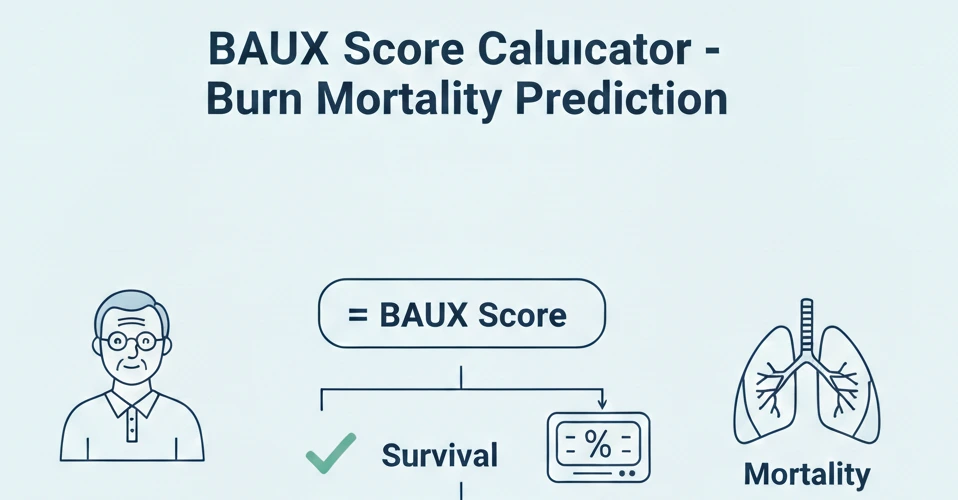
The BAUX score is a clinical formula used to estimate mortality risk after a Burn injury. It combines two primary factors:
- Patient’s age
- Total Body Surface Area (TBSA) burned
BAUX Score = Age + %TBSA Burned
For example, a 50-year-old patient with 40% TBSA burns has a BAUX score of 90. Higher scores indicate higher Mortality Risk.
Clinicians value this method because it is fast, clear, and easy to calculate. However, medicine evolves. As treatment improves, prediction models must also adapt.
Also Read: Parkland Formula Calculator | Burn Fluid Resuscitation Guide
1961 – Original Baux Score
Dr. Baux introduces a simple mortality prediction tool: Age + % TBSA burned for rapid bedside triage.
1970s–1980s – Advances in Care
Improved resuscitation, infection control, and ICU support enhance survival, slightly reducing the original score’s accuracy.
2000s – Recalibration
Analysis of large burn databases prompts refinement of the Baux Score for modern populations.
2010 – Revised Baux Score
Inhalation injury added (+17 points), improving predictive accuracy in contemporary burn care.
2010s–Present – Clinical Use
Remains widely used for ICU triage, outcome benchmarking, audits, research, and teaching.
3. BAUX Score Calculator: How It Works
The BAUX Score Calculator automates the formula so users can instantly generate results. Instead of manual addition, you enter:
- Age
- Percentage of burned body surface
- Presence of inhalation injury (for revised version)
The tool then calculates the predicted Mortality Risk in seconds.
Moreover, digital calculators reduce human error. They also allow quick comparisons in emergency settings where every minute matters.
When using a BAUX Score Calculator, remember that it provides an estimate—not a guarantee. Clinical judgment remains essential.
4. BAUX Score Calculator vs Revised BAUX: What’s the Difference?
The debate around Baux Score Calculator vs Revised Baux Score Calculator focuses on accuracy.
Original BAUX Score
- Age + TBSA burned
- Simple and widely used
- Does not include inhalation injury
Revised BAUX Score
- Age + TBSA + 17 (if inhalation injury present)
- More accurate in modern burn care
- Reflects updated survival data
Inhalation injury significantly increases Mortality Risk. Therefore, adding this factor improves prediction reliability.
Revised BAUX Score Calculator is also known as Modified BAUX Score Calculator.
When comparing Baux vs Revised Baux, most burn centers now prefer the revised version. It better reflects current outcomes and treatment advances.
5. Why Burn Mortality Risk Assessment Matters
The BAUX Score Calculator plays a critical role in emergency departments and burn units worldwide.
Severe Burn injuries can trigger infection, organ failure, and long hospital stays. Estimating Mortality Risk early helps in several ways:
ICU Clinical Support
ICU Prioritization
Optimize beds, ventilators & staffing allocation.Emergency Triage
Support rapid risk-based admission decisions.Surgical Planning
Stratify perioperative risk before procedures.Post-Op ICU Planning
Anticipate critical care requirements.Family Counseling
Provide clear, evidence-based prognosis insights.End-of-Life Support
Facilitate compassionate shared decisions.Research & Validation
Enable outcome tracking and data studies.Quality Audits
Benchmark performance and improve care delivery.Furthermore, accurate scoring systems improve communication between multidisciplinary teams.
6. Data Comparison: Original vs Revised BAUX
Below is a simplified comparison of predicted survival trends:
Survival Probability Chart
Analysis:
Studies show the revised model aligns more closely with real-world survival rates, especially in patients with inhalation injury. As a result, many hospitals now rely on the revised model rather than the original.
The BAUX Score Calculator often includes both models so users can compare outputs directly.
Try Galveston Formula Calculator for pediatric burns
7. When Should You Use a BAUX Score Calculator?
The BAUX Score Calculator is helpful in:
Burn & Critical Care Applications
Early Mortality Risk estimation using a BAUX Score Calculator helps clinicians make structured, data-driven decisions during the most critical hours after a severe Burn injury, improving triage accuracy and supporting transparent communication with families.
In addition, it supports standardized documentation. That consistency improves long-term data collection and benchmarking.
However, it should not replace full clinical evaluation. Always consider comorbidities, burn depth, and complications.
8. Latest Research on BAUX Scoring
Recent multicenter studies highlight improved survival in severe Burn patients due to advanced wound care, early excision, and critical care protocols. Researchers found that the Revised BAUX model predicts Mortality Risk more accurately in patients over 65 and those with inhalation injury. Furthermore, artificial intelligence models are being tested to enhance predictive precision beyond traditional scoring systems.
9. Clinical Interpretation Tips
Using the BAUX Score Calculator correctly requires understanding its limitations.
A lower score generally indicates better survival chances. Conversely, very high scores correlate with increased Mortality Risk.
For example:
- Score < 60 → High survival likelihood
- Score 60–100 → Moderate risk
- Score > 100 → Significant Mortality Risk
Even so, survival outcomes continue to improve with modern burn care.
The BAUX Score Calculator provides an estimate, not a definitive outcome. Individual patient factors such as comorbidities, infection, organ failure, and treatment quality can significantly influence Mortality Risk beyond what the scoring formula predicts.
10. Baux vs Revised Baux in Modern Practice
The comparison of Baux vs Revised Baux remains relevant in academic discussions. While the original model is historically important, the revised version reflects contemporary treatment outcomes.
Therefore, most institutions integrate the revised formula directly into their BAUX Score Calculator tools. Medical educators also use both versions to teach students how predictive models evolve over time.
11. Advantages of Using an BAUX Score Calculator
An online BAUX Score Calculator offers several benefits:
Moreover, digital tools improve workflow efficiency. Fast decisions can improve survival in critical cases.
Healthcare providers, students, and researchers all benefit from quick access to this calculation method.
12. Factors affecting Burn mortality
Burn mortality is predicted using Abbreviated Burn Severity Index scoring system to assess injury severity, guide clinical decisions, and improve survival outcomes in patients with severe burns.
Burn mortality is reduced by applying Evans Formula for burns to calculate fluid resuscitation needs, ensuring proper circulation and preventing shock during the critical initial twenty four hours.
Burn mortality is influenced by psychological wellbeing, as mental health is the new self care, supporting recovery, resilience, and adherence to treatment in patients suffering from burn injuries.
Burn mortality is affected by nutritional status assessed using BMI calculator, which helps determine body weight balance and guides dietary support essential for recovery in burn patients.
Burn mortality is increased by smoking and cancer risks, as tobacco use weakens immunity, delays healing, and contributes to complications that worsen outcomes in burn injury patients.
13. The Bottom Line
The BAUX Score Calculator remains a valuable and practical tool for estimating Mortality Risk in burn patients. It simplifies complex clinical data into a usable format within seconds.
Although Baux vs Revised Baux continues to be discussed, the revised model better reflects modern treatment advances. Nevertheless, no calculator replaces expert medical care.
If you work in emergency medicine, surgery, or critical care, integrating the BAUX Score Calculator into your workflow can improve assessment accuracy and decision-making speed.
Accurate evaluation saves time. In burn care, time saves lives.
14. Frequently Asked Questions
The Baux Score estimates mortality risk in burn patients by combining age and total body surface area (TBSA) burned.
Original Baux Score = Age + %TBSA burned.
The revised version adds 17 points if inhalation injury is present.
Higher scores are associated with increased mortality probability.
It is widely validated in adult burn populations but should complement clinical judgment.
Yes, it supports triage decisions and resource prioritization.
Pediatric-specific models may provide better predictive accuracy in children.
No, it supports but does not replace individualized clinical assessment.
Yes, it is frequently used in burn outcome studies and audits.
It provides instant, standardized scoring for rapid decision-making.

Worried About Breast Cancer? Check Your Risk & What to Do Next
Worried About Breast Cancer? Check Your Risk & What to Do Next Breast cancer risk…

Free Weight Loss Calculator to Find Your Perfect Calorie Deficit
Free Weight Loss Calculator to Find Your Perfect Calorie Deficit Weight Loss Calculator estimates your…

Martin Hopkins LDL Calculator for Precise Cholesterol Levels
Free Martin Hopkins LDL Calculator for Precise Cholesterol Levels Calculate your LDL cholesterol with greater…

Free BMI, BMR, Body Fat & Ideal Weight Calculator Online
BMI Calculator: Check BMI, BMR, Body Fat & Ideal Weight Track your health with our…

Ovulation / Fertile Window Calculator
Introduction Ovulation and fertile window calculators estimate cycle timing to identify days with highest conception…
LDL Calculator
3-Step LDL Calculator – Instantly Check Your Bad Cholesterol Level The LDL Calculator estimates low…
For Nutrition tips Click Here