
Toronto Formula Calculator: Burn Fluid Resuscitation
Calculate IV fluids for burn patients using the Toronto Formula Calculator.
This calculator estimates fluid requirements for adult burn patients using the Toronto Formula, prioritizing weight and percentage of body burned.
Total 24-Hour Fluid Volume
0 mL
(Ringer’s Lactate)
First 8 Hours
0 mL
Rate: 0 mL/hr
Next 16 Hours
0 mL
Rate: 0 mL/hr
Clinical Note: The Toronto formula is typically calculated as 2-4 mL × kg × %TBSA. This tool uses the standard 2mL constant as a baseline. Titrate based on urine output (target 0.5-1.0 mL/kg/hr).
Medical Decision Support Tool Only
1. Introduction
Severe burns cause rapid fluid loss, electrolyte imbalance, and shock. Early fluid replacement can save lives. The Toronto Formula offers a structured, goal-based method to guide clinicians during the first 24 hours after injury.
Unlike older fixed-volume formulas, the Toronto Formula adjusts fluids based on patient response. Therefore, it supports safer and more individualized care. In this guide, you will learn its calculation, application, monitoring process, and clinical relevance.
Early and accurate fluid management reduces complications such as acute kidney injury, compartment syndrome, and respiratory failure. A structured approach improves survival rates and shortens ICU stays. That is why understanding modern resuscitation formulas is essential for every emergency and critical care professional.
- Toronto Formula Calculator: Burn Fluid Resuscitation
- 1. Introduction
- 2. What Is the Toronto Formula?
- 3. History & Evolution
- 4. Why Fluid Resuscitation Matters in Burns
- 5. How the Toronto Formula Works
- 6. Toronto Formula vs Parkland Formula
- 7. Clinical Application in Emergency Settings
- 8. Monitoring and Assessment
- 9. Latest Research and Evidence
- 10. Benefits of the Toronto Formula
- 11. Data Comparison Graph
- 12. Practical Tips for Clinicians
- 13. The Bottom Line
- 14. Frequently Asked Questions (FAQ)
2. What Is the Toronto Formula?
The Toronto Formula is a dynamic approach to burn resuscitation. It was developed at the University of Toronto to improve outcomes in major burn injuries.
Traditional formulas estimate fluid needs based on weight and burn size. However, the Toronto Formula emphasizes urine output and physiologic response to guide therapy.
This approach aligns closely with modern concepts of goal directed burn fluid resuscitation, where treatment adapts to real-time patient data rather than fixed predictions.
3. History & Evolution
🟡 Late 1980s – Search for Better Caloric Estimates
By the late 1980s clinicians recognized that simple formulas (like the Curreri or Harris-Benedict adjusted by stress factors) often poorly predicted actual metabolic demands in burned patients. Multivariate analyses were used to derive better predictive tools by correlating measured energy expenditure with measurable clinical variables.
🔹 1990 — Clinical Validation Study
The Toronto Formula emerged from a 1990 study by J. P. Allard and colleagues published in JPEN Journal of Parenteral and Enteral Nutrition — where multiple regression analysis of clinical data revealed that a composite equation (the later-named Toronto Formula) correlated closely with measured energy expenditure in burn patients.
This represented a major shift from relying solely on basal equations + percentage TBSA to using actual clinical data (temperature, intake, days post-burn) to predict metabolic needs.
📊 1994 — Further Clinical Use and Validation
In 1994, research in adult burn units (including work affiliated with the University of Toronto burn center) confirmed that the Toronto Formula predicted resting energy expenditure well compared with indirect calorimetry in mechanically ventilated adult burn patients.
4. Why Fluid Resuscitation Matters in Burns
Burn injuries increase capillary permeability. As a result, plasma leaks into tissues, causing edema and hypovolemia.
Without rapid burn fluid resuscitation, patients may develop:
- Hypovolemic shock
- Organ failure
- Metabolic acidosis
- Reduced tissue perfusion
Proper fluid replacement restores circulating volume and protects vital organs.
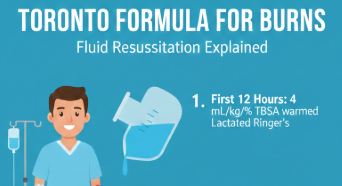
5. How the Toronto Formula Works
Initial Fluid Estimate in Toronto Formula
The Toronto Formula begins with an estimated crystalloid infusion rate during the first hours after injury. This rate is adjusted hourly based on urine output.
Unlike static formulas, clinicians continuously titrate fluids.
Target Urine Output
The key endpoint is urine output:
- Adults: 0.5–1 mL/kg/hour
- Children: 1 mL/kg/hour
If urine output falls below target, increase fluids. If it exceeds the target, reduce fluids. However Galveston Formula is preferred in children.
Therefore, the Toronto Formula promotes precision and prevents over-resuscitation.
6. Toronto Formula vs Parkland Formula
The most common comparison is with the Parkland formula.
| Feature | Toronto Formula | Parkland Formula |
|---|---|---|
| Approach | Dynamic, response-based | Fixed calculation |
| Adjustment | Hourly titration | Limited adjustment |
| Risk of Fluid Creep | Lower | Higher |
| Monitoring | Strict urine output guidance | General monitoring |
While the Parkland method calculates 4 mL × kg × %TBSA, the Toronto Formula continuously adjusts fluids based on physiologic response.
Consequently, it reduces the risk of excessive edema and abdominal compartment syndrome.
7. Clinical Application in Emergency Settings
In emergency departments and burn centers, early application of the Toronto Formula improves stability.
Step-by-Step Application
For example, if urine output drops below 0.5 mL/kg/hr, increase the infusion rate by 20–30%. Conversely, reduce fluids if output is too high.
Moreover, clinicians should assess lactate levels, blood pressure, and mental status.
Also Read: Galveston Formula for Pediatric Burns: Fluid Resuscitation Explained
8. Monitoring and Assessment
Close monitoring ensures safe outcomes. The Toronto Formula requires continuous reassessment.
Important parameters include:
These indicators reflect tissue perfusion and organ function.
Excessive fluid administration can lead to pulmonary edema, abdominal compartment syndrome, and limb compartment pressure. Therefore, avoid aggressive increases without proper monitoring. Always reassess clinical signs, laboratory values, and patient response before making major adjustments.
9. Latest Research and Evidence
Recent burn care studies emphasize individualized resuscitation strategies. Research published in major burn journals shows that goal-directed protocols reduce ICU length of stay and mechanical ventilation duration. Investigators also report fewer complications related to fluid overload when dynamic titration methods are used compared to fixed formulas.
10. Benefits of the Toronto Formula
The Toronto Formula provides several advantages:
In addition, it aligns with modern intensive care principles.
Because it adapts to patient response, the Toronto Formula enhances safety during the critical first 24 hours.
- Reduces fluid creep
- Supports organ perfusion
- Allows individualized care
- Minimizes edema-related complications
- Improves hemodynamic stability
11. Data Comparison Graph
Below is a simplified comparison of average fluid trends in the first 24 hours:
The dynamic adjustment pattern of the Toronto Formula generally results in smoother fluid administration curves compared to fixed high-volume resuscitation strategies.
12. Practical Tips for Clinicians
- Start early, ideally within the first hour of injury
- Use a Foley catheter for accurate urine measurement
- Reassess every hour during the first 24 hours
- Avoid automatic increases without checking patient status
- Collaborate with a burn specialist when possible
These steps ensure effective application of the Toronto Formula in real-world practice.
“Effective burn resuscitation is not about giving more fluid; it is about giving the right amount at the right time based on the patient’s response.”
13. The Bottom Line
The Toronto Formula represents a modern, patient-centered approach to burn care. Instead of relying solely on fixed predictions, it uses physiologic targets to guide therapy.
As burn management continues to evolve, dynamic methods like the Toronto Formula improve safety and outcomes. Therefore, clinicians should understand its calculation, monitoring principles, and clinical application.
By applying this evidence-based strategy, healthcare professionals can reduce complications and deliver better critical care.
14. Frequently Asked Questions (FAQ)


Benefits of Garlic: Fight Cancer & Boost Health
Benefits of Garlic: Fight Cancer & Boost Health 1. Introduction The Benefits of Garlic have...

How Physical Activity Helps Reduce LDL Cholesterol Naturally
How Physical Activity Helps Reduce LDL Cholesterol Naturally High LDL cholesterol silently damages your arteries...

5 Simple ways to Know You are Overweight to Act Early
5 medically accepted ways to know if you are overweight Determining whether you are overweight...
Medical Disclaimer: The Website does not provide medical, clinical, or healthcare advise services. The content should not be relied upon as medical advice. Always seek the guidance of a qualified physician, healthcare provider, or medical professional with any questions you may have regarding a medical condition, treatment, or health decision. Never disregard professional medical advice or delay seeking it because of information found on this Website.
For Nutrition tips, Click here