
Galveston vs Parkland Formula in Pediatric Burns: Which Is More Accurate?
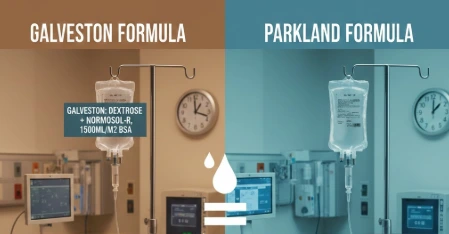
Parkland formula is weight-based whereas Galveston formula is body surface area–based
- Galveston vs Parkland Formula in Pediatric Burns: Which Is More Accurate?
- 1. Introduction
- 2. Overview of the Galveston vs Parkland in Pediatric Burns
- 3. Why Galveston vs Parkland Matters in Children
- Which Formula Should You Use?
- 4. Maintenance Fluid Advantage
- 4. How Limitations of This formula was known?
- How Limitations Were Identified
- 5. Data Comparison: Galveston vs Parkland
- 6. Monitoring and Clinical Assessment
- 7. Risk of Fluid Creep
- 8. When Parkland May Still Be Appropriate
- 9. Does these calculation in different degree of burns?
- 10. The Bottom Line
- 11. Frequently Asked Questions
- References:
Medical Disclaimer: This content is for educational purposes only and not a substitute for professional medical advice
1. Introduction
Fluid therapy is the backbone of survival in severe Pediatric Burns. Clinicians often debate Galveston vs Parkland when deciding the safest and most effective resuscitation strategy for children.
Both formulas guide early burn management. However, children are not small adults. Therefore, selecting the correct method directly affects outcomes.
The Parkland formula is based on body weight (4 mL × kg × %TBSA) and is widely used for initial burn resuscitation.
The Galveston formula uses body surface area (BSA) and includes maintenance fluids, making it more suitable for children.
👉 In pediatric burns, the Galveston formula is generally preferred because it provides a more accurate fluid requirement.
2. Overview of the Galveston vs Parkland in Pediatric Burns
Before analyzing Galveston vs Parkland, let’s review their foundations.
Parkland Formula
The Parkland formula originated at Parkland Memorial Hospital. It recommend:
4 mL × body weight (kg) × %TBSA burn
Half is administered in 8 hours, and the remainder over 16 hours.
However, it focuses only on resuscitation volume.
Galveston Formula
The Galveston formula was developed at Shriners Hospitals for Children in Texas. It calculates:
5000 mL × %TBSA burn (per m²)
- 2000 mL × total body surface area
Unlike Parkland, it integrates maintenance fluid in pediatric burn management.
| Feature | Galveston Formula | Parkland Formula |
|---|---|---|
| Calculation Design | Based on Body Surface Area (BSA) | Based on body weight (kg) |
| Best for Children | Yes – reflects higher surface area-to-mass ratio | Less precise for pediatric patients |
| Maintenance Fluids | Automatically included | Must be added separately |
| Error Risk | Lower risk of underestimation | Higher risk if maintenance is omitted |
| Fluid estimation | More precise | May underestimate |
| Use cases | Children | Adult |
3. Why Galveston vs Parkland Matters in Children
Physiology explains much of the Galveston vs Parkland debate.
Children have higher surface area-to-weight ratio So they need more fluid than Parkland predicts.
Children:
Parkland does not account for maintenance fluid in pediatric burn patients. Galveston integrates it from the start. Therefore, Galveston reduces the risk of hypoglycemia and early shock.
Which Formula Should You Use?
- Pediatrics → Galveston preferred
- Adults → Parkland standard
- Severe burns → clinical judgment required
4. Maintenance Fluid Advantage
Maintenance fluid in pediatric burn care is essential.
Infants and toddlers are especially vulnerable to glucose depletion.
With Parkland, clinicians must manually add maintenance fluid in pediatric burn resuscitation plans.
However, the Galveston formula incorporates maintenance directly into its calculation.
As a result, it simplifies clinical workflow.
This practical difference often makes Galveston safer for younger children.
4. How Limitations of This formula was known?
- Underestimates fluid needs
- Risk of under-resuscitation
- Especially in small children
How Limitations Were Identified
1. Under-Resuscitation in Children
Clinicians observed inadequate perfusion despite correct calculations.
- Hypotension
- Oliguria
- Metabolic acidosis
2. Pediatric Physiologic Differences
Children have higher BSA-to-weight ratio and greater evaporative losses.
- Higher maintenance fluid needs
- Greater surface-related fluid loss
- Maintenance not included in Parkland
3. Burn Center Outcome Reviews
Clinical audits showed improved stability with BSA-based formulas.
- Better urine output
- Improved perfusion
- Reduced metabolic imbalance
5. Data Comparison: Galveston vs Parkland
Below is a simplified comparison:
| Feature | Parkland | Galveston |
|---|---|---|
| Basis | Weight | Body Surface Area |
| Maintenance Included | No | Yes |
| Hypoglycemia Risk | Moderate | Lower |
| Pediatric Accuracy | Moderate | High |
Integrated planning reduces oversight and supports balanced resuscitation.
Here’s a clear side-by-side comparison using an example case (child, 10 kg, 20% TBSA burn):
| Feature | Parkland Formula | Galveston Formula (Pediatric) |
|---|---|---|
| Formula | 4 mL × weight (kg) × %TBSA | 5000 mL × %TBSA (m²) + 2000 mL × BSA (m²) |
| Purpose | Fluid resuscitation (mainly adults, also used in children) | Specifically designed for children |
| Calculation (10 kg, 20%) | 4 × 10 × 20 = 800 mL (24 hrs) | Depends on body surface area (≈0.47 m² child) → ~940 mL + maintenance (~940 mL) ≈ 1880 mL |
| First 8 hours | Give 50% → 400 mL | Half of total in first 8 hrs |
| Next 16 hours | Remaining 50% → 400 mL | Remaining over 16 hrs |
| Maintenance fluids | Not included | Included in formula |
| Best use | Simple, quick estimate | More accurate for children |
6. Monitoring and Clinical Assessment
Despite the differences in Galveston vs Parkland, monitoring remains the cornerstone of care. Clinicians should track:
Fluid rates must be adjusted based on response. Formulas guide therapy. Continuous reassessment ensures safety.
Over-resuscitation can lead to pulmonary edema, abdominal compartment syndrome, and worsening tissue swelling. Under-resuscitation may cause shock and renal failure. Therefore, regardless of the Galveston vs Parkland choice, hourly reassessment during the first 24 hours is critical.
7. Risk of Fluid Creep
Fluid creep refers to excessive fluid administration beyond calculated needs.
Studies associate Parkland with higher risk of volume escalation in some pediatric settings.
In contrast, Galveston vs Parkland comparisons show that integrated maintenance reduces overcorrection tendencies.
Balanced calculation decreases edema-related complications.
8. When Parkland May Still Be Appropriate
Although Galveston vs Parkland often favors Galveston in younger children, Parkland still has a role. It may be used in:
However, many pediatric centers transition to Galveston after initial assessment.
“Choosing the right resuscitation formula in pediatric burns is not about tradition; it is about physiology, precision, and protecting vulnerable organs during the most critical hours.”
9. Does these calculation in different degree of burns?
Burn fluid resuscitation formulas like the Parkland and Galveston formulas are generally used for moderate to severe burns, typically when burns involve ≥10% Total Body Surface Area (TBSA) in children or ≥15–20% TBSA in adults. They are mainly applied in second-degree (partial-thickness) and third-degree (full-thickness) burns.
First-degree (superficial) burns do not require formal fluid resuscitation because they do not cause significant fluid shifts. The calculation is based on the percentage of TBSA burned, not directly on burn degree alone, although deeper burns often involve greater fluid loss and higher resuscitation needs.
✅ Which Formula is Better for Pediatric Burns?
- The Galveston formula is generally preferred in children because it accounts for body surface area and maintenance needs.
- The Parkland formula is useful for initial estimation, but may not provide adequate fluids in pediatric patients.
10. The Bottom Line
The debate around Galveston vs Parkland centers on safety, physiology, and simplicity. For accurate fluid resuscitation in children, the Galveston formula is more reliable.
Children have unique metabolic and fluid needs. Therefore, body surface area–based calculations often provide better accuracy.
Galveston integrates maintenance fluid in pediatric burn care and reduces error risk. Meanwhile, Parkland remains effective, especially in adults.
Ultimately, understanding Galveston vs Parkland allows clinicians to tailor treatment, prevent complications, and improve survival in pediatric burn patients.
Precise calculation combined with vigilant monitoring ensures the best outcomes.
11. Frequently Asked Questions
1. What is the difference between Galveston and Parkland burn formulas?
The Parkland formula is mainly used in adults and is based on body weight and %TBSA burned. The Galveston formula is designed for children and uses body surface area (BSA) for more accurate pediatric fluid calculation.
2. What is the Parkland formula?
4 mL × body weight (kg) × %TBSA burned
Give 50% in the first 8 hours and the remaining 50% over the next 16 hours. Lactated Ringer’s solution is typically used.
3. What is the Galveston formula?
5000 mL × %TBSA × BSA (m²) + 2000 mL × BSA (m²) (maintenance fluid). It is primarily used in pediatric burn patients.
4. Why is the Galveston formula preferred for children?
Children have higher surface area relative to body weight and greater maintenance fluid requirements, which the Galveston formula accounts for more accurately.
5. Is the Parkland formula used in children?
It can be used, but it may underestimate maintenance fluid needs in pediatric patients. Pediatric burn centers often prefer the Galveston formula.
6. What fluid is used in burn resuscitation?
Lactated Ringer’s (Hartmann’s solution) is the standard initial fluid used in both formulas.
7. When should fluid resuscitation begin?
Fluid calculation starts from the time of burn injury, not from hospital arrival.
8. How is %TBSA calculated?
In adults, the Rule of Nines is commonly used. In children, the Lund and Browder chart provides more accurate estimation.
9. What is the goal of these burn formulas?
The goal is to prevent burn shock by maintaining adequate tissue perfusion and urine output.
10. Are these formulas exact?
No. They are guidelines. Fluid therapy must be adjusted based on urine output, vital signs, lactate levels, and overall clinical response.
References:
Burn Fluid resuscitation Guidelines
Early fluid resuscitation improves outcomes in severely burned children
Also Read: 7-Day Diet Plan for Weight Loss: A Powerful & Simple Reset to Kickstart Fat Loss Naturally


Benefits of Garlic: Fight Cancer & Boost Health
Benefits of Garlic: Fight Cancer & Boost Health 1. Introduction The Benefits of Garlic have…

How Physical Activity Helps Reduce LDL Cholesterol Naturally
How Physical Activity Helps Reduce LDL Cholesterol Naturally High LDL cholesterol silently damages your arteries…

5 Simple ways to Know You are Overweight to Act Early
5 medically accepted ways to know if you are overweight Determining whether you are overweight…
Medical Disclaimer: The Website does not provide medical, clinical, or healthcare advise services. The content should not be relied upon as medical advice. Always seek the guidance of a qualified physician, healthcare provider, or medical professional with any questions you may have regarding a medical condition, treatment, or health decision. Never disregard professional medical advice or delay seeking it because of information found on this Website.